How Medical Billing Services Help Reduce Claim Denials and Payment Delays
With expert medical billing services, I actively reduce claim denials, streamline revenue cycle management, and ensure timely payments for healthcare providers.

Claim denials and delayed payments are more than routine billing issues. For healthcare practice owners, they can disrupt collections, increase administrative workload, and make monthly revenue harder to predict. Even when care is delivered correctly, reimbursement can still be delayed when patient details, eligibility checks, coding, documentation, or payer requirements are not handled accurately.
A stronger billing process helps practices catch errors earlier, submit cleaner claims, track unpaid balances, and resolve payer issues faster. This is where professional support can make a measurable difference. Medical Billing & Technology Partners, LLC helps healthcare organizations improve billing workflows through claims management, denial follow-up, reporting, and technology-enabled processes designed to support a more reliable revenue cycle.
For business owners and practice managers, the goal is simple: reduce preventable revenue loss, improve collections, and give the internal team more time to focus on patient care and operations.
Why Denials and Delayed Payments Hurt Practice Performance
A denied or delayed claim affects more than one payment. It creates extra work for staff, slows reimbursement, and can increase accounts receivable if issues are not resolved quickly. Over time, recurring billing problems can make it harder for owners to plan payroll, manage expenses, or invest confidently in the practice.
Common financial and operational impacts include delayed insurer payments, higher A/R balances, more time spent on corrections, increased administrative costs, inconsistent monthly collections, and frustration for both staff and patients.
The longer a claim remains unresolved, the harder it can be to collect. That is why effective billing support is not just about submitting claims. It is about preventing avoidable issues before they become revenue problems.
Common Reasons Medical Claims Get Denied
Most claim denials come from preventable workflow gaps. These may include incorrect patient information, inactive insurance coverage, missing prior authorization, coding errors, duplicate submissions, incomplete documentation, provider credentialing issues, payer rule changes, late filing, or mismatched patient and provider details.
These problems are not always caused by lack of effort. In many practices, internal teams are simply stretched thin. Staff may be handling scheduling, patient calls, insurance questions, documentation requests, and payer follow-up at the same time. When the process is not standardized, errors can slip through and delay reimbursement.
A more structured billing workflow helps reduce these risks by improving verification, claim preparation, submission tracking, denial review, and payment follow-up.
What Industry Data Shows About Claim Denials
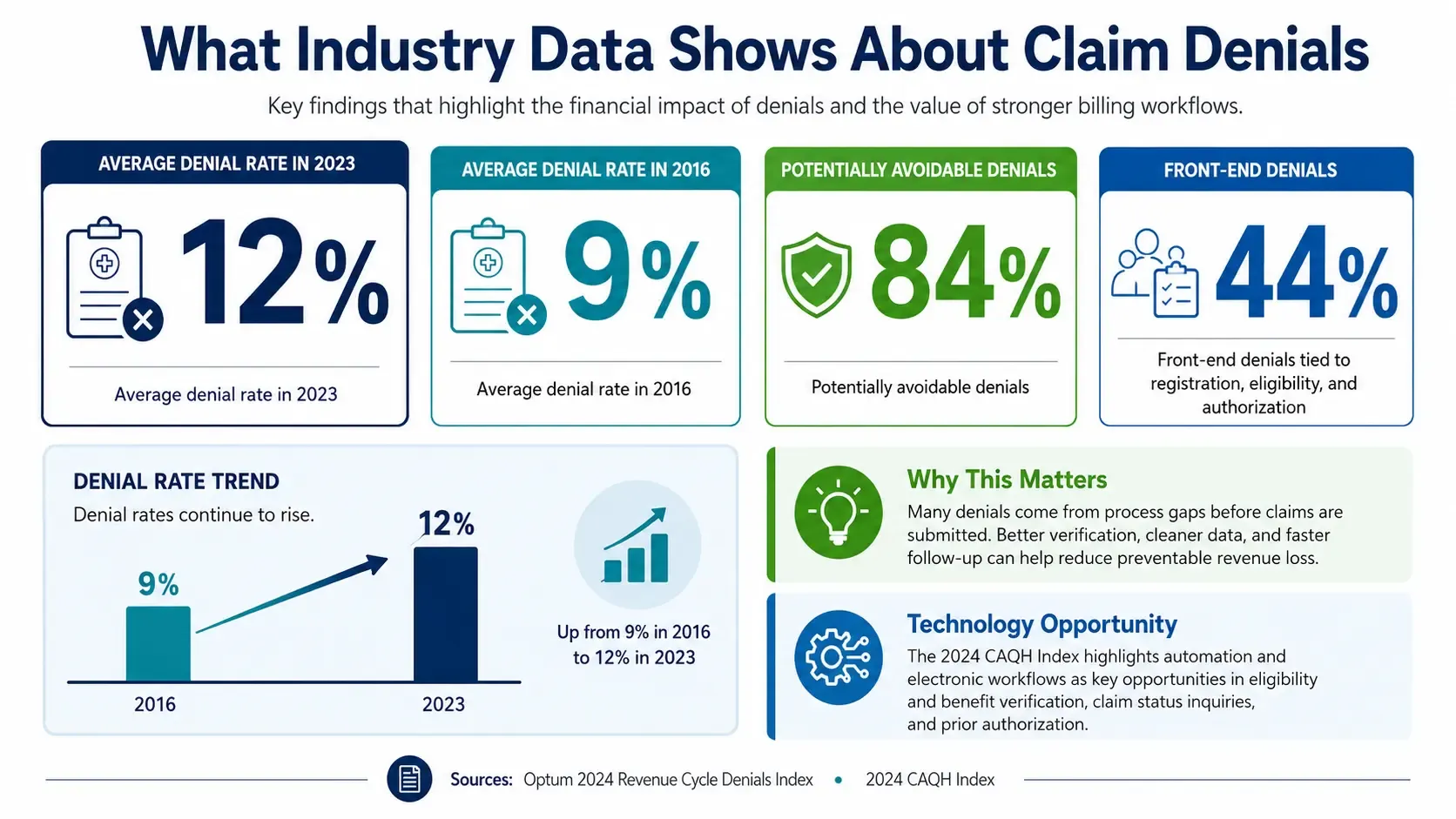
Claim denials are a measurable business issue across healthcare. According to the Optum 2024 Revenue Cycle Denials Index, the average denial rate reached 12% in 2023, up from 9% in 2016. The same report found that 84% of denials may be potentially avoidable, while 44% were front-end denials tied to early steps such as registration, eligibility, and authorization.
For practice owners, the message is clear: many denials are process problems, not just payer problems. Missed eligibility checks, incomplete documentation, inaccurate patient data, and delayed follow-up can all create avoidable revenue loss before a claim is ever paid.
The 2024 CAQH Index also highlights automation and electronic workflows as major opportunities to reduce administrative burden, especially in eligibility and benefit verification, claim status inquiries, and prior authorization.
This is why billing improvement should focus on the full workflow, from patient intake to final payment. Better systems, cleaner data, and consistent follow-up can help practices reduce preventable delays and protect revenue.
Improve Claim Accuracy Before Submission
The best way to reduce denials is to catch problems before claims are sent to payers. A proactive billing process reviews patient information, eligibility, coding, documentation, and payer requirements before submission.
Eligibility verification is especially important. If coverage details, policy status, referrals, or authorization requirements are missed early, the claim may be rejected or delayed later. Clean claims begin with accurate information at intake.
Claim review also matters. A strong billing process checks for correct patient and provider details, accurate service dates, proper diagnosis and procedure codes, required modifiers, complete documentation, payer-specific formatting, and timely filing requirements.
This approach reduces unnecessary back-and-forth with payers and gives practices a better chance of receiving payment without repeated corrections.
Strengthen Coding, Documentation, and Compliance
Coding and documentation issues are common causes of claim rejections, underpayments, and compliance concerns. Even small errors can create costly delays when payers request corrections or additional information.
A reliable billing process should review whether services are properly documented, codes match the care provided, modifiers are used correctly, and payer requirements are met. This helps reduce issues related to incorrect diagnosis codes, unsupported services, missing modifiers, incomplete notes, or mismatches between procedures and diagnoses.
For practice owners, accurate coding is not only about reimbursement. It also supports compliance, payer accountability, and long-term revenue protection.
Use Denial Management to Recover and Prevent Lost Revenue
Even with strong front-end processes, denials can still happen. What matters is how quickly they are reviewed, corrected, appealed, and tracked.
Effective denial management identifies the reason for the denial, corrects errors, resubmits claims promptly, pursues appeals when appropriate, and monitors patterns over time. Instead of treating each denial as a one-time issue, the process should uncover recurring root causes.
For example, if denials often come from missing authorizations, the practice may need stronger verification steps. If they come from coding issues, documentation review may need improvement. If they come from payer-specific requirements, the billing workflow may need better payer rules tracking.
This moves the practice from reactive claim correction to proactive revenue protection.
Reduce Payment Delays with Better Claims Follow-Up
Submitting a claim is only the beginning. Practices also need consistent follow-up to confirm whether the claim was accepted, processed, denied, underpaid, or still pending.
Payment delays often happen when teams do not have enough time or visibility to monitor claim status. Without regular follow-up, unresolved claims can age quickly and become harder to collect.
A strong billing workflow keeps claims moving by tracking payer responses, prioritizing aging balances, identifying underpayments, and escalating unresolved issues. This helps reduce the risk of claims sitting unpaid for weeks or months without action.
Improve A/R Tracking and Payment Posting
Accounts receivable can grow when unpaid claims are not monitored consistently. The longer a balance remains open, the more difficult it may be to resolve.
Accurate payment posting is also important because it shows whether claims were paid correctly, partially paid, denied, adjusted, or transferred to patient responsibility. Without clean posting, practice leaders may not have a reliable view of collections.
Better A/R tracking helps practices prioritize older balances, follow up with payers, identify slow-pay patterns, and understand where revenue is being delayed. It also gives owners clearer visibility into the financial health of the business.
What Better Billing Support Looks Like in Practice
Many billing issues begin quietly. A few claims are delayed, a few denials need corrections, and staff members try to manage follow-up between patient calls, scheduling, and other daily tasks. Over time, these small delays can turn into growing A/R and inconsistent collections.
With stronger billing support, the workflow becomes more organized. Coverage is verified before the visit, claims are reviewed before submission, payer responses are tracked, denials are categorized by reason, and unpaid balances are followed up consistently. Practice owners also receive clearer reporting, making it easier to understand where delays are happening and what actions are being taken.
This is where Medical Billing & Technology Partners, LLC provides value. MBT helps practices move from reactive billing to a more proactive process by identifying risk points earlier, reducing preventable errors, and keeping reimbursement activity organized.
In-House Billing vs. Outsourced Medical Billing
Some practices manage billing internally because they want direct control and immediate access to staff. This can work well when the team is experienced, properly trained, and supported by strong systems. However, in-house billing also requires ongoing hiring, training, software management, compliance monitoring, and staff oversight.
Outsourced medical billing gives practices access to specialized support without placing the full workload on internal staff. This can be especially helpful for practices dealing with frequent denials, delayed reimbursements, unclear reports, staff turnover, or limited billing capacity.
| Comparison Area | In-House Billing | Outsourced Billing |
|---|---|---|
| Staffing | Managed by the practice | Managed by the billing provider |
| Training | Requires ongoing internal training | Supported by billing specialists |
| Claims Follow-Up | Depends on staff availability | Handled through dedicated workflows |
| Denial Management | May be inconsistent if staff are overloaded | Structured review, correction, and tracking |
| Technology | Requires internal software use and oversight | Often supported by billing tools and reporting systems |
| Reporting | Depends on internal process and expertise | Can provide clearer performance visibility |
| Scalability | May require more hiring as volume grows | Can scale with practice needs |
For business owners, the decision is not only about cost. It is about which model creates better accuracy, stronger follow-up, clearer reporting, and more predictable collections.
How Technology Helps Reduce Denials and Reimbursement Delays

Technology plays a major role in making billing more accurate and easier to manage. For practice owners, the value is not just having software. The real value comes from using technology with the right workflows and reporting structure.
Key capabilities include eligibility verification, electronic claims submission, denial analytics, A/R tracking, reporting dashboards, and workflow automation. These tools help practices verify coverage earlier, submit claims more efficiently, monitor payer responses, detect denial trends, and prioritize unpaid balances.
Technology can also help leadership understand why payments are delayed. Issues may be tied to documentation, coding, payer response time, authorization, eligibility, or internal follow-up. When this information is visible, practice owners can make better decisions and address the actual source of the problem.
MBT’s combined focus on medical billing and technology makes this especially valuable. By aligning billing workflows with reporting tools and technology-supported processes, MBT helps practices gain clearer visibility into claims, payments, and revenue performance.
What Practice Owners Should Look for in a Billing Partner
Choosing a billing partner affects collections, accuracy, reporting, and daily operations. The right provider should do more than submit claims. They should help identify process gaps, reduce preventable denials, manage unpaid claims, and provide meaningful financial visibility.
Practice owners should look for experience in claims management, denial management, medical claims processing, payer requirements, payment posting, A/R follow-up, compliance, and healthcare billing solutions. Clear communication is also important. A practice should be able to understand what is happening with claims, where delays are occurring, and what steps are being taken to resolve them.
A strong partner should also understand how billing systems, EHR workflows, eligibility tools, and reporting dashboards work together. This helps create a more connected and accountable process.
Signs Your Practice May Need Medical Billing Support
A practice may need billing support when denials are increasing, insurer payments are slowing down, reports are unclear, or A/R continues to rise. These signs often point to deeper workflow issues that need attention.
Another warning sign is staff strain. If your team spends too much time correcting claims, calling payers, answering billing questions, or trying to interpret inconsistent reports, the current process may no longer support the needs of the business.
Inconsistent monthly revenue is also a concern. While some payment delays are normal in healthcare, repeated delays often indicate gaps in verification, documentation, claim submission, denial follow-up, or A/R management.
Frequently Asked Questions About Medical Billing Services
How do medical billing services reduce claim denials?
Medical billing services reduce denials by improving the accuracy of patient information, eligibility checks, coding, documentation, claim submission, and payer follow-up. A stronger process helps catch errors before claims are submitted and resolves denials faster when they occur.
What is denial management in medical billing?
Denial management is the process of reviewing denied claims, identifying why they were denied, correcting errors, resubmitting or appealing claims, and tracking patterns to prevent future denials.
Why are my medical claims being delayed?
Medical claims may be delayed because of missing patient information, inactive insurance, authorization issues, coding errors, incomplete documentation, payer processing delays, or lack of timely follow-up.
What is the difference between claims management and denial management?
Claims management covers the full process of preparing, submitting, tracking, and following up on claims. Denial management focuses specifically on denied claims and the steps needed to correct, appeal, and prevent them.
Can outsourced medical billing improve cash flow?
Yes. Outsourced medical billing can help improve collections by strengthening claim accuracy, follow-up, denial resolution, payment posting, and A/R tracking. Results depend on the practice’s current process and the quality of the billing partner.
What should I look for in a healthcare billing solution?
Look for a solution that supports eligibility verification, electronic claims submission, denial analytics, A/R tracking, reporting dashboards, compliance, and clear communication. The goal is to improve both billing accuracy and financial visibility.
When should a practice consider outsourcing billing?
A practice should consider outsourcing when billing workload is too high, denials are increasing, reimbursements are delayed, A/R is growing, reports are unclear, or staff are spending too much time on payer follow-up.
Strengthen Billing Accuracy and Improve Reimbursement Performance
Reducing denials and payment delays requires more than basic claim submission. It requires accurate information, clean documentation, timely follow-up, effective denial management, A/R visibility, and technology-supported workflows.
Medical Billing & Technology Partners, LLC helps healthcare practices improve billing performance through claims management, denial follow-up, payment posting, reporting, and technology-enabled support. With the right process in place, your practice can reduce preventable denials, improve cash flow, accelerate reimbursements, and increase billing accuracy.
Ready to Reduce Denials and Improve Billing Performance?
If your practice faces frequent denials, delayed reimbursements, or rising administrative strain, partnering with Medical Billing & Technology Partners, LLC can help you create a more accurate, efficient, and dependable billing process.