The Role of EMR Integration in Accurate and Efficient Medical Billing
Integrating EMR into billing process significantly boosts accuracy and efficiency in claims processing. Learn how it transformed my practice today!

Disconnected clinical and billing systems can create costly problems for healthcare practices. When patient records, encounter notes, eligibility details, and claim information do not flow smoothly between systems, staff may spend extra time correcting errors, chasing missing data, and resubmitting claims.
Electronic Medical Record (EMR) integration helps solve this by connecting clinical documentation with billing workflows. When information moves accurately from patient care to claims processing, practices can improve billing accuracy, reduce avoidable denials, accelerate reimbursements, and gain clearer visibility into financial performance.
Medical Billing & Technology Partners, LLC helps healthcare organizations strengthen this connection by combining billing expertise with technology-enabled workflows. For practice owners, the value is straightforward: cleaner claims, less manual work, stronger reporting, and a more efficient revenue cycle.
Why EMR Integration Matters for Billing Accuracy
An Electronic Medical Record (EMR) stores important clinical information such as patient history, diagnoses, treatment notes, medications, provider documentation, and encounter details. When this information is not connected properly to the billing process, staff may need to re-enter data manually or search across multiple systems.
That manual work increases the risk of billing mistakes. Missing diagnoses, incomplete documentation, incorrect patient details, mismatched codes, or delayed eligibility checks can all result in claim rejections, underpayments, or payment delays.
A connected workflow helps reduce these risks by making clinical and billing data easier to access, validate, and use before claims are submitted.
EMR vs. EHR: What Practice Owners Should Know
The terms EMR and Electronic Health Record (EHR) are often used together, but there is a slight difference. An EMR typically refers to a digital version of a patient chart within one practice or organization. An EHR is broader and is designed to share patient information across providers, systems, and care settings.
For billing purposes, both matter because the goal is the same: make sure the right clinical information supports the right claim. Whether a practice uses an EMR or EHR system, the billing process depends on accurate documentation, clean data transfer, and reliable system communication.
This is why EHR integration and EMR-connected billing workflows are important for revenue cycle optimization.
Industry Data: Why Connected Systems Matter
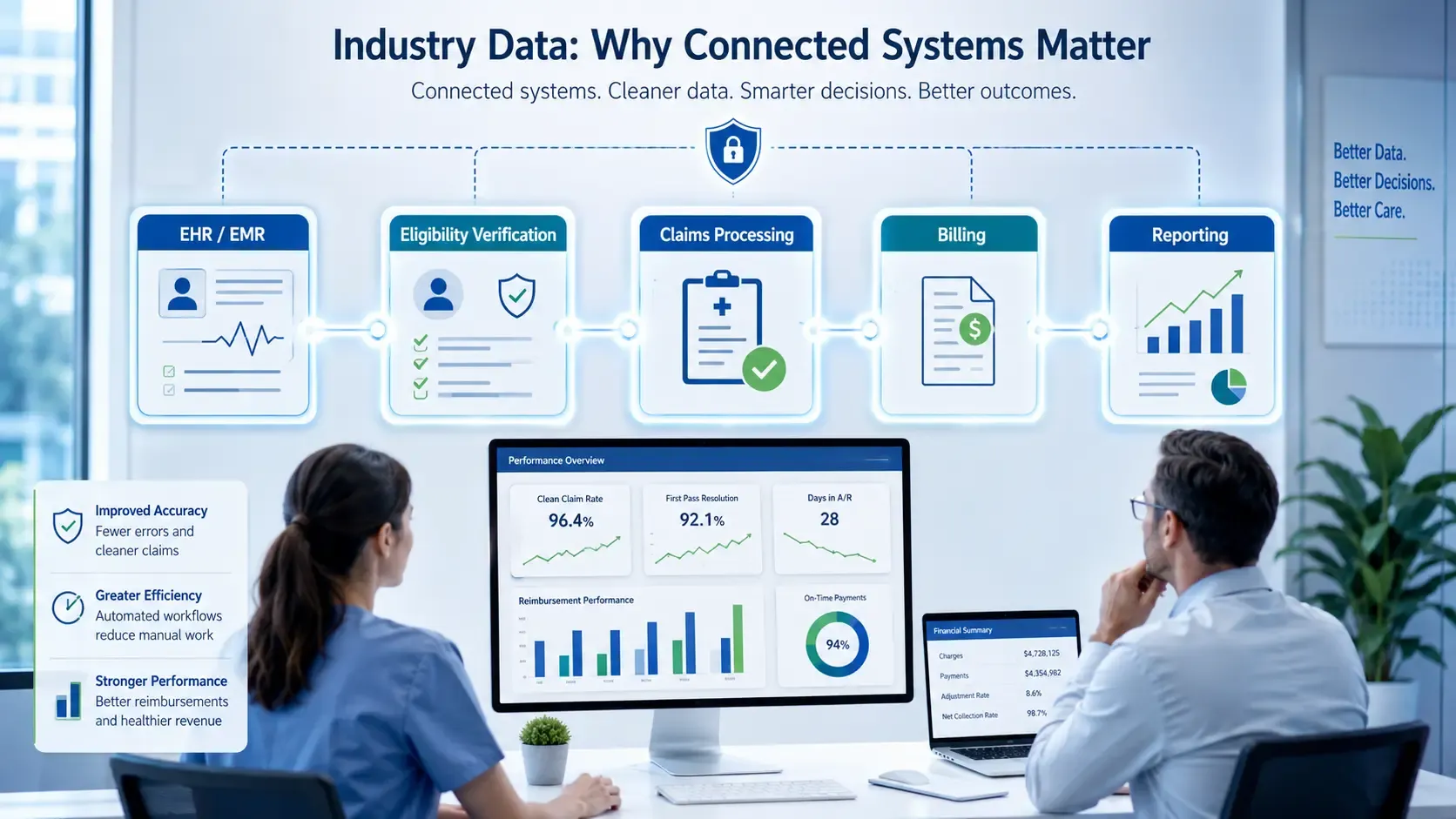
Healthcare practices have widely adopted digital records, but adoption alone does not guarantee billing efficiency. The real value comes from how well clinical records, eligibility checks, claims workflows, and reporting tools work together.
According to the CDC’s National Electronic Health Records Survey., 95.0% of U.S. office-based physicians had adopted Electronic Health Record (EHR) systems in 2024, with 83.6% using a certified EHR system. This shows that digital records are now standard across most medical practices, but it also raises an important question: are those systems helping billing teams work faster and more accurately?
Interoperability remains a major focus for healthcare organizations. HIMSS Market Insights’ 2024 interoperability research examined how healthcare leaders are addressing system connectivity, data exchange, and information gaps across technology infrastructure. For practice owners, this matters because disconnected systems can create duplicate work, missing information, and billing delays.
MGMA also emphasizes that reducing denials often requires stronger use of practice management systems, better staff training, and regular payer communication. These operational improvements connect directly to EMR-integrated billing because accurate data flow and clearer workflows help teams catch issues earlier.
For healthcare business owners, the takeaway is clear: having an EMR or EHR system is only the first step. To improve billing accuracy and reimbursement performance, practices need connected workflows that move reliable information from the patient visit to claim submission, payment posting, and reporting.
Manual Billing vs. EMR-Integrated Billing
| Comparison Area | Manual or Disconnected Billing | EMR-Integrated Billing |
|---|---|---|
| Data Entry | Staff may re-enter information across systems | Patient and encounter data can flow more efficiently |
| Error Risk | Higher risk of missing or mismatched details | Better validation before claims submission |
| Claim Preparation | More dependent on manual review | Supports cleaner claims and faster preparation |
| Eligibility Checks | May require separate verification steps | Can connect with eligibility workflows |
| Reporting | Limited visibility if data is spread across systems | Clearer tracking through dashboards and reports |
| Follow-Up | Staff may rely on manual reminders | Workflow automation can support timely action |
| Revenue Impact | Higher risk of delays and rework | Better support for faster reimbursements |
For business owners, this comparison shows why integration is not just an IT upgrade. It is a billing performance improvement.
Improve Claim Accuracy with Better Data Flow
Accurate billing starts with complete and reliable information. When clinical documentation connects directly with claims workflows, billing teams can reduce manual entry and improve claim readiness.
Integrated systems can help ensure patient demographics, diagnosis information, procedure details, provider notes, and payer requirements are available during the billing process. This reduces the risk of submitting claims with missing or inconsistent information.
Better data flow also helps billing teams catch issues earlier. Instead of discovering problems after a denial, teams can identify documentation gaps, eligibility issues, or coding mismatches before submission.
How Interoperability Standards Support Billing Workflows
Healthcare interoperability refers to the ability of different systems to exchange and use information accurately. Two important standards are Fast Healthcare Interoperability Resources (FHIR) and Health Level Seven (HL7).
FHIR helps modern healthcare applications exchange data through more flexible, API-based methods. HL7 is a long-standing standard used to structure and transmit healthcare information between systems.
For medical billing, these standards matter because they support smoother communication between clinical records, billing platforms, clearinghouses, and other healthcare systems. When data moves consistently, billing teams can work with more accurate information and reduce avoidable claim issues.
Technology Capabilities That Strengthen Claims Processing
Technology can improve billing performance when it supports the actual workflow, not just the software interface. A strong technology-enabled billing process may include API integrations, eligibility verification, electronic claims submission, claims scrubbing, AI-assisted coding support, denial analytics, accounts receivable tracking, and reporting dashboards.
These capabilities help practices identify problems earlier and respond faster. For example, eligibility verification can confirm coverage before the visit. Claims scrubbing can flag missing information before submission. Denial analytics can reveal recurring issues by payer, provider, code, or documentation type. A/R tracking can help prioritize unpaid balances before they become harder to collect.
This is where MBT’s combined medical billing and technology background becomes valuable. By aligning billing workflows with connected systems and reporting tools, MBT helps practices improve accuracy, visibility, and reimbursement performance.
How Automation Reduces Billing Errors
Medical billing automation can reduce repetitive manual tasks that often lead to errors. This may include pulling patient information into billing workflows, checking required claim fields, flagging missing documentation, or supporting electronic claims submission.
Automation does not replace billing expertise. Instead, it helps billing teams work more efficiently by reducing manual re-entry and making it easier to focus on exceptions, denials, underpayments, and payer-specific issues.
For healthcare practices, this can mean fewer avoidable mistakes, faster claim preparation, and more consistent follow-up.
AI-Assisted Coding and Denial Prevention
Artificial intelligence (AI) can support billing teams by reviewing patterns, flagging possible coding issues, and helping identify claims that may be at risk for denial. AI-assisted tools may help detect missing documentation, inconsistent coding, payer-specific concerns, or unusual billing patterns.
However, AI should be used carefully. It works best when paired with experienced billing professionals who can review results, apply payer knowledge, and make informed decisions.
For practice owners, the practical benefit is not the technology itself. The benefit is better decision support, faster issue detection, and stronger claims management.
Compliance and Data Security in Integrated Billing
Healthcare billing workflows must protect patient information and follow compliance requirements. The Health Insurance Portability and Accountability Act (HIPAA) sets standards for protecting sensitive health information.
When EMR and billing systems are connected, security should be a top priority. Practices should consider access controls, encryption, audit trails, user permissions, secure data transmission, and staff training.
A connected workflow should not only improve efficiency. It should also protect patient data and support compliant billing operations.
Common Integration Challenges
EMR-connected billing can improve performance, but implementation is not always simple. Common challenges include incompatible systems, inconsistent data fields, staff resistance, poor training, unclear workflows, and limited reporting setup.
These problems can lead to frustration if the practice focuses only on the software and not the process behind it. A successful integration requires clear workflow planning, proper system mapping, staff education, and regular performance review.
The goal is not just to connect platforms. The goal is to create a billing workflow that supports accuracy, speed, compliance, and financial visibility.
Key Metrics to Track After Integration
Practice owners should measure whether integration is actually improving billing performance. The most useful metrics include claim denial rate, clean claim rate, days in accounts receivable, claim submission turnaround time, payment posting accuracy, underpayment recovery, and reimbursement turnaround time.
| Metric | Why It Matters |
|---|---|
| Clean Claim Rate | Shows how many claims are submitted correctly the first time |
| Denial Rate | Helps identify recurring claim or documentation problems |
| Days in A/R | Measures how long revenue remains unpaid |
| Claim Submission Time | Shows how quickly claims move after the encounter |
| Payment Posting Accuracy | Supports clearer financial reporting |
| Underpayment Tracking | Helps identify payer payment issues |
| Reimbursement Turnaround | Shows how quickly the practice gets paid |
Tracking these numbers helps leadership understand whether billing workflows are improving or simply becoming more digital.
Future Trends in EMR-Connected Billing
The future of billing technology is moving toward stronger interoperability, better automation, and smarter analytics. API-based integrations, AI-assisted coding, automated eligibility checks, predictive denial tools, and real-time dashboards will continue shaping how practices manage claims and collections.
For healthcare business owners, the main opportunity is better control. As systems become more connected, practices can gain clearer visibility into where delays happen, which claims need attention, and what process improvements can protect revenue.
The practices that benefit most will be those that combine technology with strong billing operations, not those that rely on software alone.
Frequently Asked Questions About EMR Integration and Medical Billing
What is EMR integration in medical billing?
EMR integration in medical billing connects clinical documentation with billing workflows so patient information, encounter details, diagnoses, and procedure data can support more accurate claims processing.
How does EMR integration reduce claim denials?
It reduces denials by improving data accuracy, reducing manual entry, supporting eligibility checks, and helping billing teams identify missing documentation or coding issues before claims are submitted.
What is the difference between EMR and EHR integration?
EMR integration usually refers to connecting records within a specific practice or organization. EHR integration is broader and supports sharing health information across different providers, systems, and care settings.
What are FHIR and HL7?
Fast Healthcare Interoperability Resources (FHIR) and Health Level Seven (HL7) are healthcare data exchange standards. They help different healthcare systems communicate and share information more consistently.
Can EMR integration improve reimbursement speed?
Yes. When billing teams have accurate clinical data, eligibility details, and claim information earlier in the process, claims can be prepared and submitted more efficiently, helping reduce delays.
Does EMR integration replace medical billers?
No. Integration supports billing teams by reducing manual work and improving access to information. Experienced billers are still needed to review claims, manage denials, monitor payer rules, and handle complex issues.
What should practices look for in an EMR-connected billing workflow?
Practices should look for eligibility verification, electronic claims submission, claims scrubbing, denial analytics, A/R tracking, secure data exchange, reporting dashboards, and workflow automation.
Is EMR integration important for small practices?
Yes. Small practices often have limited administrative resources, so connected workflows can help reduce manual work, improve billing accuracy, and give owners better visibility into revenue performance.
Optimize Billing Accuracy with Better System Integration
Accurate billing depends on more than claim submission. It requires clean clinical data, connected workflows, reliable eligibility checks, secure information exchange, and clear reporting.
Medical Billing & Technology Partners, LLC helps healthcare practices improve billing accuracy, reduce claim denials, accelerate reimbursements, and optimize revenue cycle performance through technology-enabled billing support.
Ready to Improve Billing Accuracy with Better Integration?
Partner with Medical Billing & Technology Partners, LLC to reduce claim errors, improve workflow efficiency, accelerate reimbursements, and strengthen revenue cycle performance through technology-enabled billing support.